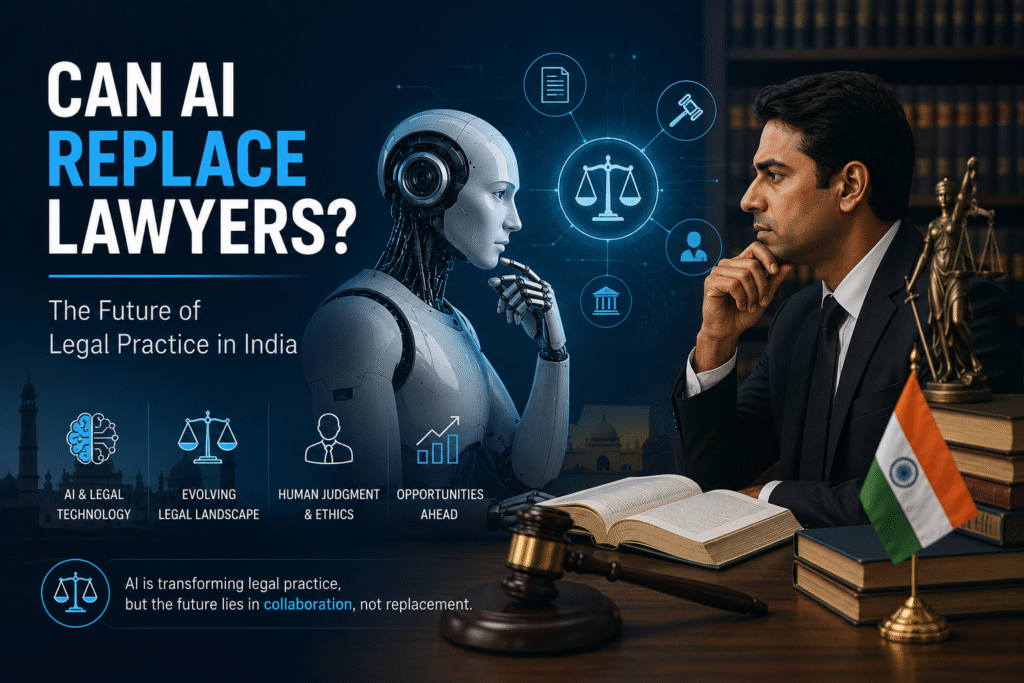
Artificial Intelligence (AI) has transformed industries ranging from healthcare and finance to education and entertainment. The legal profession, traditionally considered resistant to technological disruption, is now witnessing a significant shift. With AI-powered tools capable of legal research, document review, contract analysis, and predictive analytics, an important question emerges:
Can AI replace lawyers in India?
The answer is more nuanced than a simple “yes” or “no.” While AI is reshaping how legal services are delivered, the future of legal practice in India is likely to involve collaboration between lawyers and technology rather than complete replacement.
In this article, we examine the role of AI in India’s legal sector, its advantages and limitations, and what the future holds for aspiring and practicing lawyers.
Understanding AI in the Legal Profession
Artificial Intelligence refers to computer systems designed to perform tasks that usually require human intelligence. In the legal field, AI tools are increasingly being used to automate repetitive tasks and improve efficiency.
Some common applications of AI in legal practice include:
- Legal research and case law analysis
- Contract drafting and review
- Due diligence in mergers and acquisitions
- E-discovery and document management
- Compliance monitoring
- Litigation analytics and outcome prediction
- Client interaction through legal chatbots
Globally, law firms have adopted legal technology to reduce costs and improve productivity. India is also witnessing a gradual rise in legal-tech startups and AI-based legal solutions.
The Rise of Legal Technology in India
India’s legal system faces several challenges, including case backlogs, limited access to justice, and procedural delays. Technology has emerged as a potential solution to address some of these issues.
Several Indian legal-tech platforms now provide services such as:
- Automated document generation
- Online dispute resolution mechanisms
- AI-assisted legal research
- Digital case management systems
The push toward digitization gained momentum during the COVID-19 pandemic when virtual hearings and electronic filings became more common. As courts and legal institutions continue embracing technology, AI’s role in legal practice is expected to expand.
Tasks AI Can Perform Better Than Humans
1. Faster Legal Research
Legal research often involves analyzing thousands of judgments, statutes, and precedents. AI-powered tools can process large volumes of information within seconds, identifying relevant authorities more efficiently than traditional methods.
2. Contract Review and Analysis
AI systems can detect inconsistencies, identify risky clauses, and compare contractual terms against standard templates. This reduces the time lawyers spend reviewing repetitive documents.
3. Document Automation
Routine legal documents such as non-disclosure agreements, employment contracts, and standard notices can be generated automatically using AI-driven templates.
4. Predictive Analytics
By analyzing historical case data, AI tools may provide insights into litigation trends, judicial patterns, and possible case outcomes. Although not foolproof, such predictions can assist strategic decision-making.
5. Administrative Efficiency
Scheduling, billing, document organization, and client intake processes can be streamlined through automation, allowing lawyers to focus on substantive legal work.
Why AI Cannot Completely Replace Lawyers
Despite its capabilities, AI has significant limitations that prevent it from fully replacing lawyers.
1. Lack of Human Judgment
Legal practice involves interpreting facts, understanding context, and applying principles of justice. Human judgment remains essential, particularly in complex cases where ethical and social considerations play a critical role.
2. Emotional Intelligence and Client Counseling
Clients often seek reassurance, empathy, and strategic guidance during difficult situations such as divorce, criminal proceedings, or family disputes. AI lacks the emotional understanding required for effective client relationships.
3. Courtroom Advocacy
Advocacy is more than presenting legal arguments. It involves persuasion, negotiation, spontaneity, and responding to judicial observations in real time. These skills are inherently human.
4. Ethical Responsibility
Lawyers are bound by professional ethics and duties toward their clients and the court. Questions surrounding accountability arise when AI systems make errors or generate inaccurate legal advice.
5. India’s Diverse Legal Landscape
India’s legal system is influenced by regional languages, local customs, socio-economic realities, and evolving jurisprudence. The complexity of these factors makes complete automation difficult.
The Future: Lawyers Working Alongside AI
Rather than replacing lawyers, AI is likely to redefine their roles.
Future lawyers may increasingly rely on technology for routine tasks while focusing on areas requiring creativity, advocacy, and strategic thinking.
The legal professional of tomorrow will need to combine:
- Legal expertise
- Technological literacy
- Analytical skills
- Problem-solving abilities
- Strong communication skills
- Ethical decision-making
Law firms that successfully integrate AI into their workflows may gain a competitive advantage through increased efficiency and reduced operational costs.
Opportunities for Law Students and Young Lawyers
The rise of AI does not signify the end of legal careers. Instead, it creates new opportunities.
Emerging career paths include:
Legal Technology Specialist
Professionals who bridge the gap between law and technology.
Legal Operations Manager
Experts responsible for improving efficiency within legal departments.
Compliance and Risk Consultant
Specialists who use AI tools to monitor regulatory compliance.
Online Dispute Resolution Practitioner
Lawyers trained in resolving disputes through digital platforms.
Data Privacy and Cyber Law Expert
As technology expands, the demand for specialists in privacy and cybersecurity law continues to grow.
Law students who embrace technological advancements are likely to remain relevant in an evolving legal marketplace.
Challenges of AI Adoption in India
Although AI offers significant benefits, several challenges remain.
Data Privacy Concerns
Sensitive client information must be protected from unauthorized access and misuse.
Regulatory Uncertainty
India currently lacks a comprehensive regulatory framework governing AI usage within legal practice.
Digital Divide
Smaller law firms and practitioners in rural areas may struggle to adopt expensive technological solutions.
Reliability Issues
AI systems can generate inaccurate or misleading outputs, requiring careful human supervision.
Will AI Replace Lawyers in India?
The more realistic question is not whether AI will replace lawyers, but which lawyers will adapt to AI and which will not.
AI is expected to replace certain repetitive tasks rather than the legal profession itself. Lawyers who refuse to embrace technological developments may find themselves at a disadvantage compared to those who leverage AI to enhance productivity and client service.
History demonstrates that technological innovation changes professions rather than eliminating them entirely. Just as calculators did not replace accountants and computers did not replace teachers, AI is unlikely to eliminate the need for lawyers.
Instead, it will reshape the legal landscape and redefine how legal services are delivered.
Conclusion
Artificial Intelligence is undoubtedly transforming the practice of law in India. From accelerating legal research to automating documentation, AI has the potential to improve efficiency and accessibility within the justice system.
However, law remains fundamentally a human profession rooted in judgment, ethics, empathy, and advocacy. These qualities cannot be replicated by machines.
Therefore, AI is unlikely to replace lawyers in India. Instead, it will replace certain traditional methods of working. The future belongs to lawyers who understand both law and technology and use them together to serve clients more effectively.
For law students, advocates, and legal professionals, the message is clear: adaptation is no longer optional—it is essential.
Frequently Asked Questions
Can AI completely replace lawyers in India?
No. AI can automate repetitive tasks, but human judgment, advocacy, and ethical decision-making remain indispensable.
Will AI reduce job opportunities for lawyers?
Certain routine roles may evolve, but new opportunities in legal technology, compliance, cyber law, and legal operations are emerging.
How is AI used in the legal profession?
AI assists with legal research, contract analysis, document automation, litigation analytics, and administrative functions.
Should law students learn about AI?
Yes. Understanding legal technology can improve employability and prepare students for the future of legal practice.
What is the future of legal practice in India?
The future is likely to involve collaboration between lawyers and AI tools, leading to more efficient and accessible legal services.
really helpfull thankyou
Excellent analysis! AI may transform the way lawyers work, but it cannot replace the human elements of empathy, strategic thinking, and courtroom advocacy. The legal profession in India is evolving, and adaptability will be the key to success.
“An insightful article on how AI is reshaping the legal profession in India. While AI can simplify legal research, drafting, and data analysis, it cannot fully replace lawyers because legal practice also depends on human judgment, ethics, negotiation, and emotional intelligence. The future seems less about replacement and more about collaboration between AI and legal professionals.”
Great content! Keep up the good work!