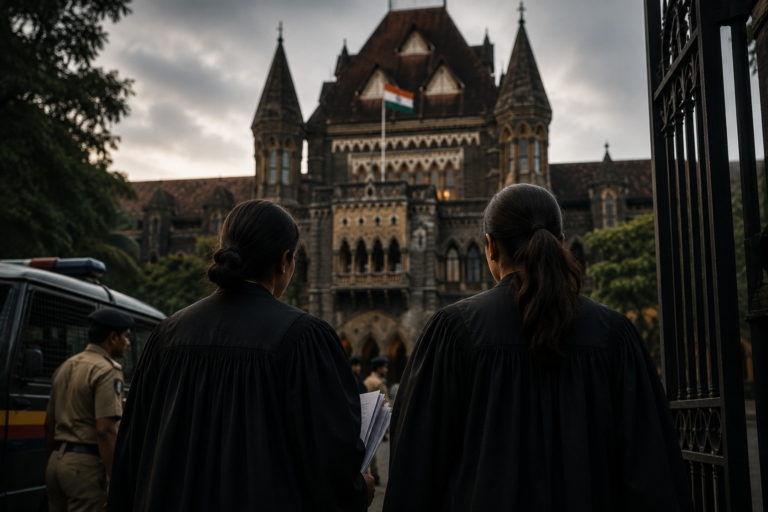
The Bombay High Court has sought a response from the Maharashtra government and other concerned authorities on a petition filed by two women advocates who have alleged serious acts of police high-handedness, including midnight abduction, illegal detention, physical assault, custodial torture and theft of valuables and legal documents.
Advocates Kirti Ahuja and Kanika Ahuja have approached the High Court seeking an independent investigation into the alleged conduct of senior Pune Police officials. The petitioners have claimed that a large police team entered a residential premises in Pune during the early hours of June 17, 2026, and detained several people without following due legal procedure.
The matter, titled Kirti Ahuja and Anr v. State of Maharashtra & Ors., was heard by a Bench comprising Justice Sarang V. Kotwal and Justice Ranjitsinha R. Bhonsale. The Court issued notice to the respondents and directed that the matter be taken up after two weeks.
The allegations made in the petition are serious and raise questions concerning the safeguards applicable to arrest, detention, search and custodial treatment, particularly when the allegations are directed against law-enforcement authorities themselves.
Table of Contents
ToggleWomen Advocates Seek Independent Investigation
According to the petition, the two lawyers have sought an investigation that is independent of the police officers allegedly involved in the incident. They have requested either a judicial inquiry headed by a sitting or retired High Court judge or a probe by the Central Bureau of Investigation (CBI).
The petition names the State of Maharashtra and the CBI as respondents. It also refers to senior police officials, including Pune Police Commissioner Amitesh Kumar and Additional Commissioner Tejasvi Satpute.
The petitioners have alleged that the incident was not an ordinary police operation but involved serious procedural and constitutional violations. They have claimed that the police action was connected to civil litigation involving prominent real estate developers, in which the advocates were representing parties.
It is important to note that these allegations are presently claims made by the petitioners and are yet to be adjudicated by the Court.
Alleged Midnight Police Operation in Pune
One of the central allegations concerns an alleged police operation carried out at around 1:40 AM on June 17, 2026.
The petitioners have claimed that approximately 200 police personnel arrived at Kirti Ahuja’s residential premises in Pune. According to their account, the personnel allegedly arrived in a combination of private SUVs and police vehicles.
The petition further alleges that some members of the police team were carrying equipment such as gas cutters and sticks. A significant number of officers were allegedly dressed in civilian clothing and, according to the petitioners, were not wearing visible nameplates.
The advocates have alleged that the police team entered the premises and detained around 24 people who were present there. The alleged detainees reportedly included guests, tenants, an elderly woman and an infant.
The petitioners have questioned the legality of the alleged detention and have claimed that the police did not produce or rely upon appropriate search warrants at the time of the alleged operation.
If established, such allegations could raise significant concerns regarding compliance with statutory safeguards governing searches, arrests and detention. However, the factual and legal validity of these claims remains to be examined during the proceedings.
The petition also contains allegations of physical violence against the lawyers.
Kanika Ahuja has alleged that male police officers physically assaulted her during the episode. She has further claimed that her clothes were torn and that she sustained injuries to her chest and back.
The allegations extend beyond the initial police action at the residential premises. The lawyers have also alleged that they were subjected to custodial torture.
Such allegations are particularly significant because custodial violence has repeatedly been treated by Indian courts as a serious violation of individual dignity and personal liberty. Law-enforcement agencies have extensive powers to investigate crime, but those powers remain subject to constitutional and statutory limitations.
The petitioners have therefore sought an investigation by an authority independent of the officers accused of wrongdoing.
At this stage, however, the Court’s issuance of notice should not be interpreted as a finding that the allegations have been proved. A notice merely requires the concerned respondents to respond to the claims raised before the Court.
Alleged Connection With Real Estate Litigation
The advocates have also suggested a possible motive behind the alleged police action.
According to the petition, the two lawyers were handling civil litigation involving substantial financial interests and prominent real estate developers. They have alleged that the police operation was intended to interfere with or undermine the litigation in which they were involved.
The petitioners have claimed that the alleged police action was therefore not merely an investigation but an attempt to disrupt their professional and legal activities.
These allegations, if substantiated, could raise questions concerning the independence of policing and the potential misuse of state machinery in private disputes.
However, the alleged connection between the police action and the civil litigation is also a matter that would require evidence and investigation. At present, it forms part of the petitioners’ case before the High Court.
Allegations of Damage, Removal of Property and Legal Files
The petition contains several other allegations concerning what allegedly happened during the police operation.
The lawyers have claimed that power connections at the premises were cut and that CCTV cameras were disabled. They have further alleged that valuables and cash were taken from the property.
More significantly from a legal perspective, the petitioners have alleged that original legal case files were also taken away.
The allegation regarding legal files is particularly noteworthy because advocates’ case records can contain documents relating to ongoing litigation, instructions from clients and material connected with pending legal proceedings.
If the allegation is established, questions could arise regarding the authority under which such material was allegedly taken and whether appropriate procedures were followed for its seizure and preservation.
The petitioners have therefore placed these allegations before the High Court as part of their broader claim that the police action amounted to an abuse of authority.
Another important aspect highlighted in the petition relates to the timing of the alleged FIR.
The petitioners have claimed that the police justified their operation by stating that it was undertaken pursuant to an FIR. However, according to the lawyers, the relevant police station records indicate that the FIR was registered at approximately 4:12 AM.
This, they argue, was several hours after the alleged detention that began during the early-morning operation.
The petitioners have relied upon this alleged discrepancy to question the chronology and legality of the police action.
The timing of an FIR can be legally significant depending upon the circumstances of a particular case. A substantial difference between the alleged commencement of detention or police action and the formal registration of an FIR may require the investigating authorities and the Court to examine the surrounding circumstances carefully.
Whether the alleged discrepancy actually demonstrates illegality, however, will depend upon the evidence and the explanation provided by the police authorities.
Complaint to Maharashtra DGP
The advocates have also claimed that they attempted to raise their concerns before the senior police administration.
According to the petition, an administrative complaint was submitted to the Director General of Police, Maharashtra, concerning the alleged conduct of the police officials.
The petitioners have alleged that instead of being independently examined, their complaint was forwarded back to the same police officers against whom the allegations had been made.
They have challenged this approach as inadequate and have relied upon it to support their request for an independent inquiry.
The argument essentially centres on the principle that allegations against police personnel should be investigated through a mechanism capable of maintaining public confidence in the impartiality of the process.
Bombay High Court Issues Notice
After hearing the petition, the Division Bench comprising Justice Sarang V. Kotwal and Justice Ranjitsinha R. Bhonsale issued notice to the respondents.
The Court has listed the matter for further hearing after two weeks.
At this stage, the Court has not made a final determination regarding the truth of the allegations. The respondents will have an opportunity to place their version and relevant records before the Court.
The next stages of the proceedings could therefore be important in determining how the allegations are addressed and whether the Court considers an independent investigation or judicial inquiry necessary.
What Have the Petitioners Asked the Court to Do?
The reliefs sought by the advocates include an independent investigation into the alleged conduct of the police officers.
Among other things, the petition seeks:
- An inquiry by a sitting or retired High Court judge;
- Alternatively, an investigation by the CBI;
- Appropriate criminal proceedings against officials found responsible for wrongdoing;
- Examination of the alleged illegal detention and assault;
- Investigation into the alleged removal of valuables, cash and legal documents; and
- Examination of the alleged discrepancies concerning the registration and timing of the FIR.
The petition thus goes beyond seeking compensation or individual relief. It asks for institutional scrutiny of the alleged police conduct.
Legal Significance of the Case
The case is significant because it involves allegations against law-enforcement officials relating to some of the most fundamental protections available to individuals under Indian law.
The Constitution protects personal liberty and provides safeguards against arbitrary deprivation of liberty. Arrest and detention are not powers that can be exercised without procedural restrictions. Similarly, police investigations and searches are governed by legal requirements intended to prevent abuse of authority.
When allegations of assault or torture arise in custody, the issue becomes even more serious because a person detained by the State is in a position of particular vulnerability.
The case also highlights the importance of accountability mechanisms within policing. An investigation into allegations against police officials must inspire confidence that the evidence will be examined fairly and without institutional bias.
At the same time, the principle of fairness applies to the accused officers as well. Allegations made in a petition are not equivalent to a judicial finding of guilt. The concerned authorities must be given an opportunity to respond, and the allegations must ultimately be tested against documentary, medical and other evidence.
A Case to Watch
The Bombay High Court’s decision to issue notice places the allegations formally before the judicial system and requires the concerned authorities to respond.
The next hearing may provide greater clarity on the police version of events, the alleged FIR timeline, the circumstances surrounding the detention of the occupants and the basis on which the police operation was conducted.
For the two advocates, the case represents an attempt to secure an investigation outside the control of the officers they have accused of misconduct. For the police authorities, the proceedings provide an opportunity to explain the circumstances of the operation and address the allegations made against them.
The case is therefore likely to remain significant not only for the parties involved but also for the broader questions it raises about police accountability, custodial safeguards, professional independence of lawyers and the protection of personal liberty.
As the proceedings continue, the focus will now be on the responses filed by the State and the police authorities and on whether the Bombay High Court finds sufficient grounds to order an independent judicial or CBI investigation.
For now, the allegations remain allegations, and the final determination will depend on the material placed before the Court and the findings reached during the judicial process.